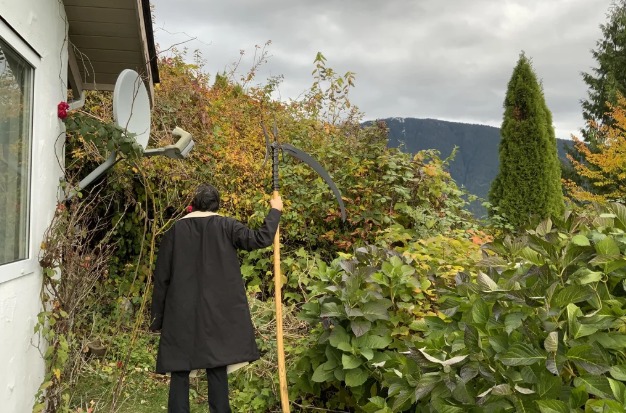
Scythe School
Scythe School is built on one rule: structure before momentum. The scythe is an uneven external object, not an “extension of the arm.” So we train the body like a chassis—quiet spine, rooted feet, clean vectors—then we earn speed.
Our Foundations
We borrow the best of traditional training and apply it to modern scythe handling. Not as cosplay, and not as a “style,” but as a practical system for control, safety, and repeatable skill.
Kung Fu Rootedness
Rooted feet and stacked posture so the weapon moves around the structure—not the structure chasing the weapon. This is where stability, balance, and torque safety come from.
- Spine stacked: head–ribcage–pelvis
- Neutral pelvis, calm trunk pressure
- Rooted stance without stiffness
Yoga Spine & Breath
Yoga isn’t “stretching” here. It’s spinal integrity under load. Breathwork keeps the ribcage stacked, the shoulders down, and the mind steady while the scythe moves.
- Quiet spine under leverage
- Nasal cadence & posture control
- Mobility with structure intact
Boxing Engine
Boxing gives us the engine: timing, distance, and footwork that keeps the body organized under pressure. Not bouncing for show—just clean positioning and recovery.
- Range control and angles
- Micro-steps and resets
- Rhythm without wasted motion
Niten Ichi-ryu Influence
We take inspiration from Niten Ichi-ryu as a mindset: directness, simplicity, and efficiency. No decorative motion. No extra steps. Every action has a purpose. The scythe is trained the same way: clean intent, clean line, clean return.
- Directness: Point A → Point B → return becomes the default.
- Economy: minimal movement, maximum control.
- Composure: calm posture while the weapon does the work.
What We Train
Stillness Training
Static holds and mid-cut freezes build the “brake system.” If you can stop the blade on command, you can add momentum later without losing your spine.
- Guard holds (30–60s)
- Mid-cut freezes (2–3s)
- Return-to-guard discipline
Vector Cutting
We don’t “swing.” We cut with intent. Every slash has a line, a destination, and a controlled return—without posture collapse.
- Short-path precision
- Deceleration control
- Repeatable blade paths
Progressive Speed
Speed is not the start. Speed is the result. We build structure first, then layer tempo—only as long as technique stays clean.
- Tempo ladders: slow → medium → fast
- Quality standards under fatigue
- Recovery steps and resets
Start Here
If you’re new, start with the principles and the stillness work. Heavy scythe builds structure and brakes. Light scythe builds pathways and repeatability. Together they forge real control.
“Quiet body. Clean line. Earned momentum.”